Due to various constraints within the Aerospace and Defense domain there is an ever increasing need to reduce maintenance costs and increase asset availability across fleets. The need to simplify the way maintenance is planned and executed has become a major issue in these domains. Manufacturers are continuously striving to develop assets with low maintenance demands, while operators strive to keep their maintenance costs as low as possible throughout the life of the asset. Often these requirements for reduced operating and maintenance costs are primary requirements in the selection criteria of assets by operators.
Many manufacturers in turn in their striving to reduce cost have taken on board philosophies to determining the maintenance regime under which asset need to be maintained. The most common approach in the Aerospace domain is the Maintenance Steering Group (MSG)-3 philosophy. This is a task-based maintenance philosophy that looks at maintenance more at a task-level as compared to previous philosophies which were more focused on maintenance packaging according to Block Check concepts.
The objective of IFS/Heavy Maintenance is to support cost-effective maintenance planning, packaging, execution and control of maintenance leading to reduction in direct maintenance costs, yet ensuring that the reliability of assets are maintained.
IFS/Heavy Maintenance covers major maintenance, repair and overhaul or upgrade activities on vehicles such as aircraft (fixed and rotary wing), vessels, submarines and complex land vehicles. Such maintenance is typically performed on a regular basis in maintenance shops and often comprises deep strips, major modifications or upgrades.
IFS/Heavy Maintenance can be used as a standalone solution or in support of the IFS/Fleet and Asset Management solution. It can also be used in conjunction with IFS/Component MRO or IFS/Complex Assembly MRO to prove a complete depth MRO solution to any service provider.
Managing the maintenance of complex assets is a problem that involves matching a large and dynamic list of maintenance work requirements against finite sets of resources (e.g., people, facilities and specialized tools and equipment) and time constraints. The Heavy Maintenance solution has the additional complexity of dealing with a wide variety of tasks, including removal and testing, inspection, non routines, replacement of most components on the assets all of which cause diverse demands and workloads on parts, tools, labor and skill requirements within the maintenance facility.
Complex assets require regular inspection and maintenance based on calendar age, hours used and/or cycles of operation and as such aircrafts, vessels, land vehicles and other major systems have limits on their life in service before deep maintenance or overhaul is required. Often throughout the life of an asset there are streams of modifications, safety directives (Airworthiness Directives) and service bulletins emanating from manufacturers or authorities which need to be applied against individual assets which necessitate specialized skills and facilities to achieve. All this work needs to be packaged up into a series of maintenance checks resulting in work packages requiring several weeks in a maintenance facility. Efficient packaging and scheduling of these work packages through a maintenance facility plays an important part in maximizing the availability of a fleet for usage.
Characteristics of heavy maintenance visits are:
Various service providers approach the control of throughput of a heavy maintenance visit in different ways, namely:
IFS Applications provide tools for managing all of these characteristics and aspects and for supporting the various approaches to managing maintenance visit throughput within a maintenance facility.
Following is a list of key terms and concepts used within the context of the IFS/Heavy Maintenance solution.
- Execution phase
- Instruction location
- Competence
- Zone
- Function number
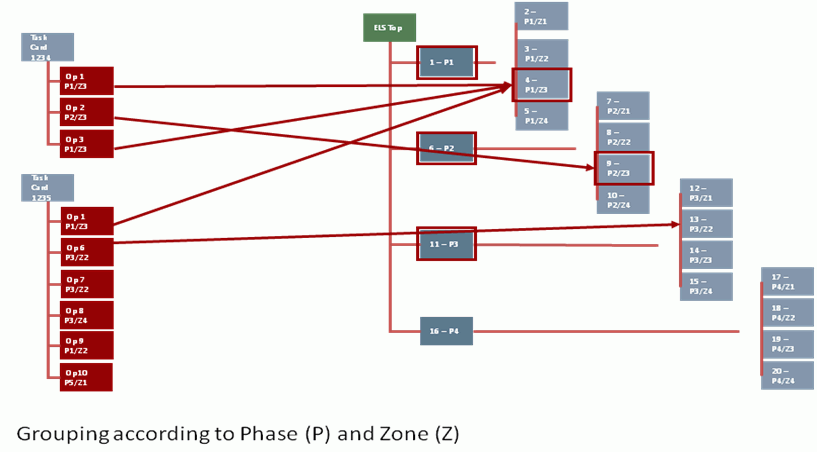
The following schematic provides an idea of how the grouping could occur based on a certain selected criteria:
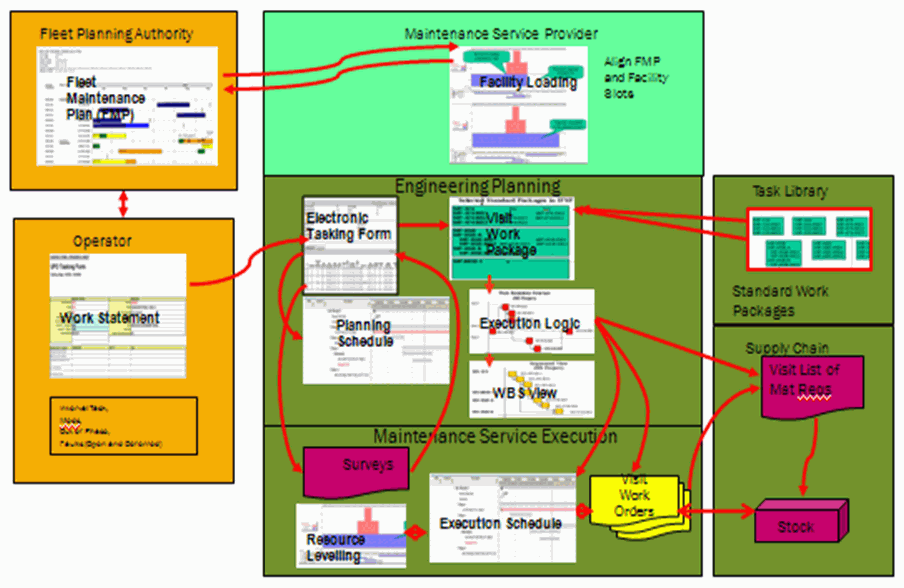
A conceptual overview of a basic heavy maintenance visit concept with interaction between a service provider and operator is as follows:
Fleet Planning - Fleet operators require the greatest degree of up-time from their assets as they can possibly achieve within the constraints of the minimum maintenance requirements as specified both by the OEM of the equipment and in some instances by the safety authority for said asset types. As such, fleet planners within the operator space need to ensure that not all assets are in maintenance at the same time and this requires smoothing of maintenance visits across a period of time. The outcome of this planning activity is often referred to as the Fleet Maintenance Plan (FMP) and is a result of balancing the needs of operations with the needs for maintenance.
Heavy Maintenance Plan - Once a FMP has been compiled, the fleet operator negotiates with various service providers for support to execute some of the heavy maintenance visits of their assets. The service providers in turn need to ensure that maximum usage of their available resources, both personnel and facilities, can be achieved within various requests for service. Once agreement between an operator and service provider is reached an agreement often referred to as the Heavy Maintenance Plan/Depth Plan is established. This sets out in the broadest terms when an asset type will be visiting the service provider for a specific event, the expected type of service to be provided (often the maintenance event type is specified, i.e., Major Service or D Check of aircraft), how long the asset is earmarked to be at the service provider's location and also any major AD, SB, Life-limited Part replacement and defects etc which could form part of the visit. Once this has been concluded the detail planning for the maintenance visit resides with the service provider, however there is a constant exchange of information between the operator and the service provider to ensure that the earmarked asset achieves its intended visit date and that the contents of the visits do not change to dramatically.
Detail Planning - Even before an asset is induced into a service provider’s facility for the agreed maintenance visit a degree of planning occurs. This comprises of the determination of the major task of the visit, decisions on how to arrange, group and sequence the visit, how to load the facilities and resources, how to balance the workload within the maintenance facility as well as across shared services, i.e. paint shops and other back shops. Some of the actions performed as part of this includes:
Execution - Once the asset arrives the detail plan is translated into an execution plan and the generation of work orders for execution and control occurs. The contents of the visit may either be revised by the removal of certain maintenance tasks or expanded due to the addition of more tasks. As inspections are performed, failures or non routines will be discovered which in most instances would require correction as part of the visit to ensure that the asset can be returned to a safe condition for release to service. These non routines are incorporated into the visit scope according to the agreement between the service provider and operator. On completion of the visit the asset is returned to the operator, the Heavy Maintenance Plan updated and any contractual arrangements closed off.
IFS/Heavy Maintenance combines several main processes. To achieve a complete solution for heavy maintenance the solution integrates various IFS Applications components—IFS Maintenance, IFS/Vehicle Information Management (IFS/VIM), IFS/Engineering, IFS/Project Management, IFS Finance, IFS Human Resources and IFS Distribution—and provides capabilities within the following key areas:
However, before any of these processes can be initiated for a maintenance visit a substantial amount of basic and operational data needs to be set up. This basic and operational data setup is performed within various IFS Applications components namely IFS/VIM and IFS Maintenance. In preparation for a heavy maintenance visit, the master configuration for an asset type needs to be defined, the maintenance program for the asset type needs to be created and the serial instance of the asset needs to be created and connected to the maintenance program requirements for the asset type. Details of these capabilities can be found within the following processes: Manage Master Configuration, Manage Maintenance Program and Manage Serialized Configuration.
All these preparation activities are necessary because the configuration management, maintenance task library and serial instance identification along with the identification of the contents of a maintenance visit instance resides in IFS/VIM while the execution of the actual work is performed within IFS Maintenance through the use of work orders. During the execution, feedback is continuously sent back to IFS/VIM, ensuring that rules and restrictions are followed and the task card closure is effectively recorded and that history records reflecting these details are updated.
The features of IFS/Heavy Maintenance offer the following benefits: